

Today I’m writing about freelancing within web development and how it can be, if done well, a highly rewarding and lucrative type of employment that opens doors to a whole host of varied projects and industries but not without its risks and potential pitfalls. Read on to find out more.
What is Freelancing?
So, what is freelancing to the uninitiated. Freelancing is a form of self-employment where individuals offer their skills and services to clients on a project or contract basis, rather than working as a full-time employee for a single company. It involves managing all aspects of the business, including marketing and finances, as well as the day-to-day work of coding and hosting websites and applications. It has become more popular since the mid-noughties, where working remotely and from home became more of a reality for many people with the evolution of the internet being a major factor and at its peak in 2020 it contributed £162bn to the UK economy.
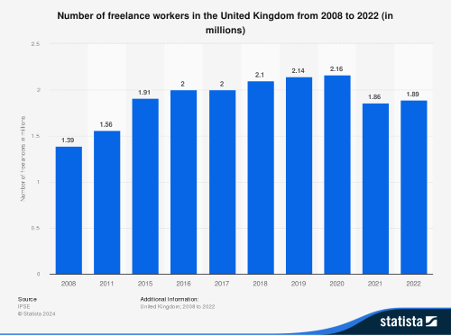
Number of freelance workers in the UK 2008-2022. Source: Statista
The graph above from statista shows the growth of freelance workers in the UK from 2008 to 2022 with a clear upward trajectory until 2020 when the covid-19 pandemic really hit freelancer workers hard especially in the creative industries. The number of freelancers is recovering but is not yet back to its pre-pandemic levels.
Can Anyone Freelance
Having established what freelancing is and what kinds of industries it is more common, what skills do you need to be a successful freelancer other than technical and problem-solving skills in your chosen field.
Driven
I guess this is more of a personality trait than a skill but underlying any individual’s decision to go freelance there will be a sprinkling of entrepreneurial spirit and drive to be successful which will require a lot of self-motivation, business nous, and ability to work independently and often long hours. This also requires strategic thinking as the work that is taken on needs to be of benefit to them and not be high risk, low reward contracts which could end in failure ‐ the ability to set a price and schedule for a contract which works for all parties will be an essential part of winning work and being paid a fair wage for it.
Networking Skills and Being a Confident Self-Promoter
This can be via LinkedIn and other social media sites promoting your portfolio, participating in online forums, attending conferences, and relevant meetups, traditional job sites, referrals from previous clients, and generally just putting the word out that you are open to work through your contacts within the industry.
There are also freelance websites such as Upwork, Freelancer, or Fiverr where you can pitch for work and promote your work – however how much value these sites give to freelancers is questionable as this blogger lays out.
Communication and Negotiation
Being able to effectively promote yourself and subsequently being able to close a contract requires a high level of communication skills be it in-person, over the phone or via email or online. Often the contracts freelancers are pitching for are up for tender against other freelancers or companies, so being able to negotiate a best deal that will win the work but also be favourable to the freelancer in terms of renumeration and time committed to the project is essential.
Organisation and Time Management
Being a team of one means all admin falls at the feet of the freelancer so being well organised to deal with all the financial, client admin, and networking alongside the actual day-to-day of freelance work requires good time management and being able to be self-disciplined. For example, carving out a few hours for menial tasks such as the accounting side of things so this doesn’t build up over time and become a burden that effects other parts of being a freelancer would be a crucial time and workload management trait. Using organisational software such as Trello and financial help software such as FreshBooks can help with the burden of taking on all tasks required to be a successful freelancer. This article in Forbes reckons good management of your time enables you to work smarter, not harder.

Continuous Improvement and Willingness to Adapt
This is a vital skill that any freelancer requires as contract work can often involve working with varied individuals and companies who use different tech stacks so being able to adapt to these is essential for efficient working. Obviously being a specialist in a particular stack is the norm for most developers, being freelance may require crossing tech stacks form one project to the next.
The Pros and Cons to Freelancing
There are many advantages to freelancing that can really enhance job satisfaction and freedom but they are not without their downsides as laid out nicely in this Upwork article. Below I list some of the good and bad of going freelance.
Pro: Flexibility
Being able to pick your work and work independently working to your own schedule and not dictated by office hours is one of the major draws of working freelance.
Pro: Building a Brand in Your Image
Effectively running your own business, you can build a personal brand that matches your style and personality and eventually pick and choose your projects ‐ for example if you are passionate about photography, you can position yourself as the developer of choice for photography brands that need websites and apps carving out a niche. This is where building a professional reputation really matter and can help with referrals and meaning work comes to the freelancer in time, rather than the freelancer searching for the work. You can read my professionalism article here.
Pro: Unlimited Earning Potential
Working freelance gives the chance of a far higher earning potential although this probably won’t happen overnight and will take several years to fulfil. Being able to manage costs, set rates, picking jobs to maximise time and earnings, and working independently means the take home pay should eventually be higher for a freelancer than working for a company as an employee.
Pro: Geographical Freedom
In theory working freelance you can be based anywhere in the world so opportunities for work aren’t limited to the city or even the country that the freelancer resides. Being a digital nomad has become more of a trend in a post covid world.
Pro: Skills Development and Job Satisfaction
A freelance web developer will often have to work across many different programming languages, platforms and frameworks as well as having to effectively manage time and other admin and business-related tasks so will develop a broader skillset. This can keep work interesting and lead to enhanced job fulfilment than if you working as an employee in a specific role, which may use the same languages and platforms, and of course without the day-to-day running of a business.
Con: Financial and Job Insecurity
Although earning potential in theory can be far greater than working for a company there is also the financial instability of not having the guaranteed pay packet at the end of each month. Some months there may be no income coming in if a freelancer is in-between projects or struggling to find the next lead. Often having to pitch for projects and go in search of their next job means that planning ahead can be difficult, this is especially true when starting out and trying to establish networks that lead to more stable work streams and job security.
Con: Stress and Isolation
Being a team of one has its benefits but also drawbacks in that every decision rests on the freelancer and the repercussions of that decision wholly their responsibility. This can be overwhelming at first and can be a stressful time, especially if the decisions have an impact on income and work stability.
Con: Long Hours
Ok being able to set your own schedule and hours is a great draw to being freelance but in reality, and especially towards a deadline, a freelancer may find themselves working long hours in order to finish a project or piece of work.

Con: Standing out in a Competitive Field
The competition for freelance work is often fierce so being able to sell your work for a rate that guarantees financial stability is a balancing act and one that may be tricky to begin with. This is where having a strong portfolio and building a reliable network of contacts to reinforce your previous work is a huge benefit.
How to Setup as a Freelancer
In theory the barriers to going freelance in terms of setup costs are relatively low but there are several things that are essential to have and consider before going it alone.
Portfolio Site
A place to showcase previous work and what you can offer to future projects and a bio describing you and your achievements is a must for a web developer who goes freelance. Being able to use this as a marketing tool to refer potential clients to, and potential clients being able to search the web and get in contact with you for work is a minimum requirement.
Registering as Self-Employed
Once you start earning money as a freelancer you need to register as self-employed and register that you are working as either a sole trader or a limited company. When working for yourself you are required to deal with all tax assessments and payments so will need to bear this in mind each year.
Upfront Costs
Knowing what cost you will incur before you make a penny is vital ‐ costs of hosting, subscriptions for software and business tools for example as these will be upfront costs that have to be swallowed before any income comes in and need to be factored in.

Know the Competition and what you are Worth
Knowing who you are competing against is vital as you can set the standard of where you need to be to be competitive, also knowing what they charge and what you can charge is important so you can win work and be profitable. This blog sets out a useful guide to how one might go about setting up their business.
Have a Plan
Lastly, planning on how you are going to win clients and what your USP’s are with a clear business plan is a very important step before taking the plunge. You need to have ideas on how you are going to make a living form freelancing and gaining clients will be core to this, maybe you want to offer free consultations or a specialised service in a particular sector to differentiate, this should all be thought through in a clear and realistic plan before you start out.
Conclusion
Freelancing wont suit everyone ‐ long hours working in isolation, a high level of self-discipline, unstable work and income, and being able to effectively manage projects solo isn’t for everyone, so being able to cope with these along with other potential pitfalls is essential if you want to make freelancing a success.
Freelancing is something I have considered and bought a short course on how I might be able to set myself up as a web development business owner, however I feel that I need to gain industry experience and a better network of contacts before I consider actually going down the freelance route, especially in a challenging time for freelancers.
From my research for this article I would suggest that anyone thinking of going freelance in web development find a niche and specialise but don’t stand still - keep learning, create a deep network of contacts in the field before setting out, use time saving tools to help with the day-to-day management and to be prepared for a few years of financial and job insecurity.